My dad has been using the same computer since 2014, and it’s been failing by degrees for the past couple of years now. A few weeks ago, he finally bit the bullet and upgraded to a new machine running Windows 11.

Friends and enemies: I cannot overstate the extent to which Windows 11 is a fucking nightmare, built to harass and exploit the average user at every turn. My dad’s a reasonably tech-savvy guy, but if I weren’t constantly on hand to deal with all the dark pattern button prompts and notification spam he’s been getting from his own fucking OS, this 73-year-old man would be trapped in a hell from which there is no escape.

As a solution, a few of my associates have recommended switching my dad (again, 73 years old) over to Linux. I will not be doing that.

Podcast Appearance: I Will Fight You

On this episode of I Will Fight You, we bring our friend Tanner Vogelgesang onboard to talk about John Waters’ Serial Mom. We then proceed to spend most of the episode gushing about Kathleen Turner and her facial acting.


Listen Here
( Read more... )

-K

In the British government’s latest round of throwing policy at the wall to see what sticks, a bill has just cleared parliament that would permanently ban tobacco products (cigarettes, vapes, dip, etc) for anyone currently under the age of 18.

To be clear: this is not just a ban on smoking for under-18s. It’s already illegal to smoke in the UK if you’re a minor. What this bill proposes is that, if you were born on or after January 1, 2009, you would not be allowed to buy or consume any tobacco product ever, in your life.

You may or may not know this about me, but I’m descended from a long line of thieves, smugglers, and enemies of the state. My great-grandfather, Harry Walker, was a runaway Barnardo Home Boy, rum-runner, World War I veteran, and rural policeman. There is considerable overlap between some of those life stages. Apparently, the only reason he wasn’t kicked out of the Alberta Provincial Police for bootlegging is because he appealed to his local member of parliament—incidentally, also one of his customers—who got him transferred to the Royal Canadian Mounted Police instead. The APP was disbanded shortly afterward.

So when I heard about this upcoming ban, every one of my ancestors sat up and recognized it as a foundation for the easiest bootlegging operation of all time.

Think about it! You wouldn’t even have to go through the hassle of smuggling the product over the border. Tobacco would remain legal to import and sell in the UK; everyone born before 2009 would still be allowed to smoke, after all. All you’d need to do is legally buy the product in bulk, then sell it off at a markup to all the pissed off twenty-somethings who missed the boat. And as time went on, your customer base would only get bigger.

Anyway, if the bottom falls out of this whole writing thing, you’ll find me on the streets of Newcastle selling loose cigarettes.

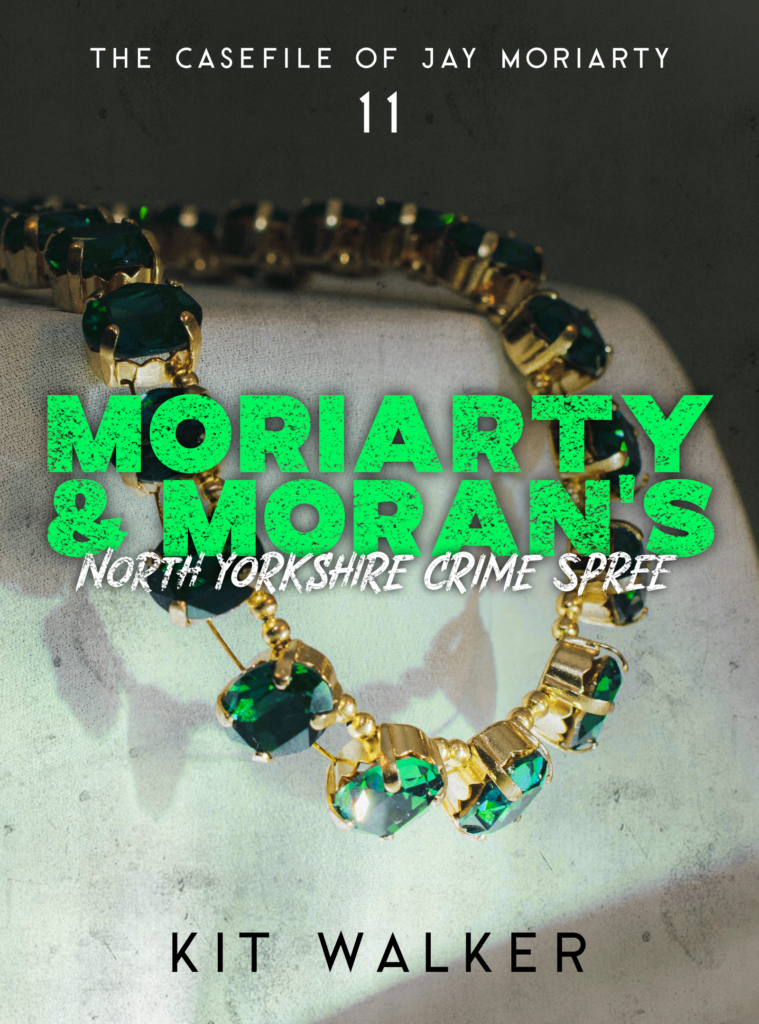
New Novelette: “Moriarty & Moran’s North Yorkshire Crime Spree”

A brutal encounter with the horrors of his own past has left Sebastian Moran unmoored and exhausted — so his partner, Jay Moriarty, takes him out of London and rents a quiet cottage in Yorkshire. As Moran struggles through a storm of conflicting emotions, Moriarty is determined to help. He wants Moran to feel secure. He wants him to feel capable. So Moriarty and Moran are going to steal just about everything in the county that isn’t nailed down.

“Moriarty & Moran’s North Yorkshire Crime Spree” is the eleventh story in my series The Casefile of Jay Moriarty, a modern-day queer take on the iconic Sherlock Holmes villain, his partner Sebastian Moran, and the various crimes they commit together.

This one’s a story about navigating a sexual relationship with someone when their trauma keeps looming over the both of you and you’re not really sure what to do about it. It’s also a story about stealing from the English for fun and profit.

It therefore contains, as my friend Ian described it, “twenty pages of theft and fucking.”

Read it Here
( Read more... )

-K

Alyx Jones is an independent game developer from the UK. She’s been working on The Quiet Things, a deeply personal game about sexual abuse, trauma, and survival. A trailer for The Quiet Things was slated to be shown during the BAFTA Games Awards on April 17; for an independent developer, this was a huge opportunity.

Until the trailer was pulled from the show at the last minute.

Jones reports that she had already revised the trailer once because BAFTA flagged certain imagery (“an object inspection of a craft knife and a statue breaking out of a mirror”) as potentially violent. Not only is this silly on its face, it’s also incredibly weird considering how permissive game trailers usually are when it comes to violent imagery; to list just one example, the Baldur’s Gate III announcement trailer features a man vomiting his own teeth.

Nevertheless, Jones made the requested changes; she was then informed, the night before the awards ceremony, that her trailer had been pulled from the show anyway. The stated reason was that “there wasn’t enough time to put the appropriate warnings in place for the audience.”

24 hours is more than enough time to throw some white text on a black screen with a list of trigger warnings. Even a live warning from someone onstage with a microphone would take less than 10 seconds.

A responsible journalist would be hesitant to draw any hard and fast conclusions from all this, but I’m not a journalist. I’m an artist — one who’s experienced my own fair share of corporate meddling in my work. And if I were in Alyx Jones’ position, I would quite confidently believe I was being jerked around by someone who never intended to let my game see the light of day.

BAFTA has since stated that they “fully support games that engage with difficult subjects, and we made the decision in relation to our event only and with the wellbeing of all guests as our priority.” I’m not sure what the word “support” is supposed to mean in this context, considering what they put Alyx Jones through; if they’re not willing to broadcast a 2-minute trailer in support of games like The Quiet Things, what are they willing to do?

The use of words like “wellbeing” is also telling.

For the record, Jones’ trailer is incredibly tame; it features first-person game footage of the player character walking through various environments while characters in voiceover talk around the protagonist’s traumatic experiences in vague terms. The trailer only alludes to sexual assault; there’s a brief bit of VO where the main character says “stop” twice in a distraught voice.

This, apparently, is too distressing for the average BAFTA viewer — because trauma stemming from sexual abuse, especially childhood sexual abuse, is so stigmatized in polite society that we’d all rather pretend it doesn’t happen. Even the gentlest reminder that it exists is tantamount, in the eyes of some, to a psychic assault. For the sake of everyone’s mental health, victims must be silenced.

Incidentally, this exact stigma is what The Quiet Things was created to address. You can watch the trailer here.

( Read more... )

-K

I started using Scrivener in 2012 or so, and I’ve kept the same license going ever since — despite the fact that support ended for my version of Scrivener years ago. I’m now at the point where the app crashes on two startups out of every three. Upgrading to the latest version of Scrivener would cost me $80, so I figured I’d try out some other (cheaper) writing apps and see if they were viable options instead.

This is how I found out I am yet again a severe edge case with the workflow of an insane person, and Scrivener is more or less the only writing app with a design that accommodates my bullshit.

I guess I’m spending $80.

Podcast Appearance: I Will Fight You

On this episode of I Will Fight You, we attempt to say The Bye-Bye Man with a straight face (0% success rate) and find out what happens when somebody decides to make a horror movie by just slapping random spooky elements together.


Listen Here
( Read more... )

-K

Book publisher Hachette has pulled out of its deal with author Mia Ballard over accusations that her novel, Shy Girl, was written with the assistance of a large language model.

I say “accusations” because the actual evidence here is pretty thin. The arguments presented are all either “the writing looks like AI” or “we ran bits of the novel through an AI detector and it told us the text was AI-generated.”

First off, human beings are quite bad at telling the difference between machine-generated and human-generated art. The logical inconsistencies in Shy Girl's plot and prose could be the result of a chatbot overrunning its context window, or just sloppy writing, or (considering the subject matter) a deliberate attempt at surrealism. Most of the “obvious tells” of LLM-generated text (em dashes, rule of three, etc.) are actually features of a formal African English education, because LLMs were largely trained by criminally underpaid African workers. And guess who most often gets accused of “sounding like a chatbot”?

Then we get into AI detection tools, which The New York Times claims to have used. Many “AI detectors” also use machine learning to some degree — analyzing and comparing two sets of text is something LLMs are built to do — but these tools tend to produce a lot of false results. The differences between human-generated text and machine-generated text are going to be largely invisible to an LLM designed to mechanically produce text that could plausibly pass as something a human wrote.

And that’s not even getting into the “AI detectors” that simply paste the submitted text into ChatGPT and ask it, “hey, did you write this?” To quote a friend of mine with approximate knowledge of many things, “anyone who tells you they have a tool to accurately detect AI is probably a liar, and liars love to use AI, so it’s probably just feeding the text into ChatGPT and asking.”

Three years ago, I noted that because “it looks like it was made by AI” is an accusation that can’t be proven right or wrong, it would inevitably be used as an ideological bludgeon against any art an accuser personally didn’t like very much. And now it looks as though a lot of people really didn’t like Shy Girl, didn’t think anyone else should like Shy Girl, and found the perfect way to bully it off the market.

(Does it feel good to be right all the time? No, it’s awful.)

Trying to suss out whether a book was written using an LLM or not is, in my opinion, pointless. A book should be criticized on the basis of whether it sucks — and, so far, provably LLM-written books have universally sucked. When an LLM manages to write a novel that’s actually good, we can revisit this topic.

And I’m fine with making it a rule that nobody can publish a novel they didn’t personally write, but in that case someone should have a word with Tom Clancy’s corpse.

( Read more... )

-K

It’s fascinating to me how the cultural object of The Book, defined as a physical stack of paper with words in it, generates so much more excitement than an ebook. Both take arguably the same amount of effort, and yet one “counts” as an achievement in a way that the other doesn’t.

Anyway: The Book.

New Release: The Casefile of Jay Moriarty, Collected Edition

A modern day re-imagining of Sherlock Holmes’ most famous enemies!

Following his polite ejection from the SAS at the end of a decade-long military career, Captain Sebastian Moran is at loose ends. Between cheating at cards and freelance jobs as a security consultant, he’s just barely managing to keep busy — but when a routine penetration test goes awry, Moran is thrown into the path of a brilliant, short-tempered hacker named Jay Moriarty.

Up until now, Moriarty has worked alone. But Moran is clever, unpredictable, and unlike anyone Moriarty has ever met, and the attraction between them quickly escalates into an intense, confusing relationship.

Together, Moriarty and Moran must face an aerospace executive covering up a deadly secret, a real estate developer who will do anything to climb the social ladder, a famous author funding a hate movement, a holiday resort full of international gangsters, and the treasonous leader of a rogue mercenary company.

Collects the first five installments of Kit Walker’s Casefile of Jay Moriarty series, revised and edited, plus three bonus stories!
Get the Paperback | Get the eBook

Paperbacks are currently only available from Amazon, but will be arriving on DriveThruFiction soon! If you want your copy fast, get the Amazon edition. If you’re willing to wait for higher print quality, stay tuned for a link to the DTF edition.

( Read more... )

-K

When I was a kid, my mom explained to me why she didn’t really enjoy Mother’s Day: she felt as if celebrating mothers one day a year gave everyone free reign to take them for granted during the other 364. I kind of got it after a while, but I couldn’t relate — until the corporate world started making such a big fucking deal out of International Women’s Day.

A few years ago, one of my previous employers released a promotional IWD video in which various female employees explained how the company made them feel included and supported. The next year, that same company fired its majority-female office support staff and hired them back as contractors so it wouldn’t have to pay them benefits.

Another year, a different company I was working for at the time decided to commemorate IWD by giving all the women in the office (or everyone perceived as a woman, anyway) a potted plant and a personalized card featuring quotes from famous women throughout history. As a dyke with a case of the Genders who had no interest in going to paint nite, I was firmly on the margins of the “Women of [COMPANY]” social group; the card perfectly encapsulated that whole state of affairs. It featured a quote from Margaret Thatcher.

You know, noted LGBT ally Margaret Thatcher.

The plant was also a bit on-the-nose. “Here is a thing you are now responsible for keeping alive whether you like it or not. Happy International Women’s Day.”

( Read more... )

-K

A few days ago, a mutual of mine on Tumblr asked a pretty interesting question: “why do people get uncomfortable with political fanfic?” She went on to point out that “A lot of you love to boast that you love the dirtiest, nastiest smut ever, why can’t you handle someone writing ‘fascism is bad’?”

It reminded me of the time a book marketer told me The Casefile of Jay Moriarty was too political for queer romance readers, and too gay for political thriller readers. As if those two categories were completely mutually exclusive.

Fanfiction and romance fiction have a lot in common, and not just because fanfic tends to have a lot of sex and romance in it. Both are capable of being really really good — like, “permanently alters your brain chemistry, haunts you for the rest of your life” good — but are largely viewed as inherently frivolous. Both mediums are often read, written, and published by people who don’t particularly give a shit (much to the frustration of readers, writers, and publishers who do).

And so, very often, a reader going into a fanfic or romance novel will be doing so with the expectation that these works are low-effort; that the experience they’re about to have won’t make them think or feel anything complicated. When that assumption turns out to be untrue — when the work demands effort on the part of the reader — they respond negatively. It’s the literary equivalent of a pillow princess suddenly being asked to top.

However, just because I understand this viewpoint doesn’t mean I have to respect it. Fuck your comfort, I’m trying to do something interesting out here. To quote Bruce Sterling, “You can get a hell of a lot done in a popular medium just by knocking it off with the bullshit.”

( Read more... )

-K

Conventional publishing wisdom holds that you’re supposed to adopt a buzzy, overexcited tone when announcing the release of a new book, the better to build up hype. I’m not sure that wisdom holds when the book in question is about a very serious, very horrible thing that won’t stop showing up in the news while you’re writing and publishing the book.

New Novella: “A Reckoning in Whitehall”

Jason Collier is on his way up in the world. Wealthy and well-educated, he’s translated a successful business career overseas into a parliament seat at home in Britain. His marriage to one of the world’s most powerful tech executives has made him a key asset to the government. It is, in light of all this success, of little concern to anyone who matters that Collier has left a trail of violated and abused victims behind him.

Jay Moriarty certainly isn’t anyone who matters — but twenty years ago, Jason Collier hurt a boy named Sebastian Moran. For that, Moriarty is going to destroy him.
Read it Here

“A Reckoning in Whitehall” is the tenth story in my series The Casefile of Jay Moriarty, a modern-day queer take on the iconic Sherlock Holmes villain, his partner Sebastian Moran, and the various crimes they commit together.

This one gets pretty heavy. It’s about abuse and sexual violence, and the ways in which they’re enabled by structures of power. I originally hashed out the concept early last year in an attempt to understand what were, back then, current events; I was not expecting it to be even more relevant by the time it came out.

I put a lot of love, anger, and grief into “A Reckoning in Whitehall.” It’s not a nice story, but I did my best to make it an honest one.

( Read more... )

-K

Draft2Digital has just rolled out distribution through Bookshop.org, which means a bunch of my books are now available on Bookshop. However, it looks like Bookshop is blocking distribution for titles that are under a certain length. My short stories haven’t made it onto the site; neither have any of the Saintstown books, nor the first Casefile of Jay Moriarty book.

Some other writers are also reporting that their erotica books were blocked from distribution through Bookshop. According to Draft2Digital, this isn’t a blanket ban; they claim “additional safeguards” are needed before erotica can be sold on Bookshop, and that “support is coming soon.” I can only assume these “safeguards” will include age verification, which presents its own issues.

It would certainly be a wild choice for Bookshop to suddenly ban sex books, considering how hard they’re riding the Heated Rivalry hype wave. I’ve seen other platforms try to thread the needle between romance and erotica by claiming erotica is “for the purpose of titillation/arousing sexual desire,” and meanwhile romance … isn’t, I guess? I think BookTok would disagree with that assessment.

And also, as I’ve pointed out before, who gets final say over the “purpose” of a piece of art? Who gets to decide whether I’m a pornographer? And why is a pornographer such a terrible thing to be?

I suspect this tension between a publishing industry going all-in on “spicy” romance and a retail industry desperate to crack down on any and all “adult” content will come to a head sooner rather than later.

( Read more... )

-K

Links

syndicate

RSS Atom

style credit