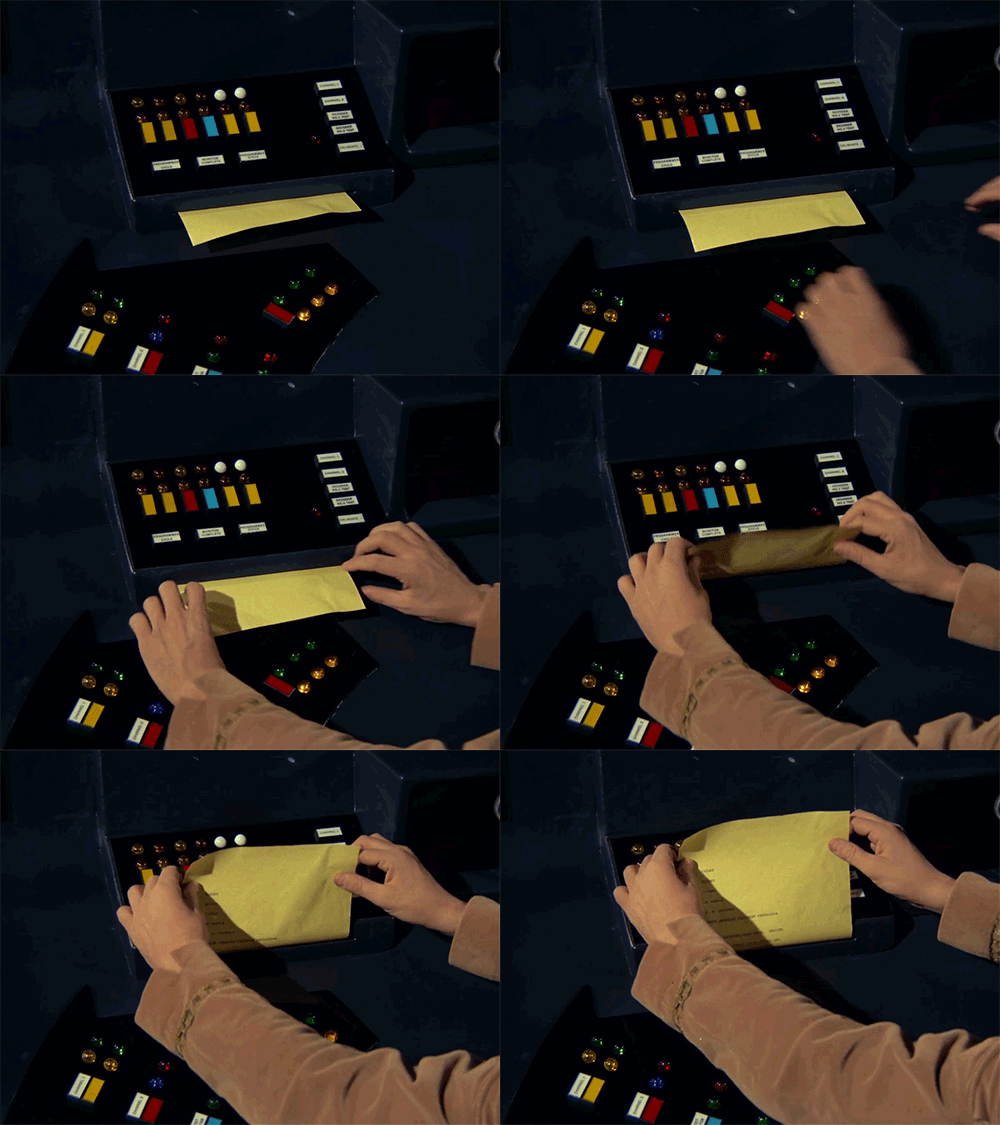
A few days ago, a mutual of mine on Tumblr asked a pretty interesting question: “why do people get uncomfortable with political fanfic?” She went on to point out that “A lot of you love to boast that you love the dirtiest, nastiest smut ever, why can’t you handle someone writing ‘fascism is bad’?”

It reminded me of the time a book marketer told me The Casefile of Jay Moriarty was too political for queer romance readers, and too gay for political thriller readers. As if those two categories were completely mutually exclusive.

Fanfiction and romance fiction have a lot in common, and not just because fanfic tends to have a lot of sex and romance in it. Both are capable of being really really good — like, “permanently alters your brain chemistry, haunts you for the rest of your life” good — but are largely viewed as inherently frivolous. Both mediums are often read, written, and published by people who don’t particularly give a shit (much to the frustration of readers, writers, and publishers who do).

And so, very often, a reader going into a fanfic or romance novel will be doing so with the expectation that these works are low-effort; that the experience they’re about to have won’t make them think or feel anything complicated. When that assumption turns out to be untrue — when the work demands effort on the part of the reader — they respond negatively. It’s the literary equivalent of a pillow princess suddenly being asked to top.

However, just because I understand this viewpoint doesn’t mean I have to respect it. Fuck your comfort, I’m trying to do something interesting out here. To quote Bruce Sterling, “You can get a hell of a lot done in a popular medium just by knocking it off with the bullshit.”

Read more... )

-K

For what may be obvious reasons, I recently read every story in the original Sherlock Holmes canon — all four novels and 56 short stories.

(This is not bragging. 56 is not that many. Harlan Ellison, one of my favourite writers, is said to have written over 1 000 short stories in his lifetime. You’re welcome to try and verify that claim, but you’ll probably get distracted by the “Controversies and disputes” section of his Wikipedia page.)

The Holmes stories were written before we as a culture fell from god’s grace and invented sequel hooks. As a result, I was struck by the fact that some of the canon’s most famous characters appear quite suddenly and don’t stick around for very long.

An example: if you asked the average person to name three Sherlock Holmes characters, they’d probably say “Holmes, Watson, and Moriarty.” But Professor Moriarty only factors into two stories, and personally appears in just one: "The Final Problem," in which he pops up out of nowhere to kill Holmes. The second story, The Valley of Fear, takes place before "The Final Problem" but was published 21 years later, establishing Moriarty as a recurring threat well after the fact.

Another example: if you asked the average person to name three Sherlock Holmes characters, but stipulated at least one of them had to be a woman, they might say "Holmes, Watson, and Irene Adler." Because Adler is the Woman — the woman who bested Sherlock Holmes.

spoilers for basically any Sherlock Holmes adaptation that has Irene Adler in it )
And finally, this work is also dedicated in furious disgust to ridding our world of the influence of everyone complicit in using the pandemic as a tool for their own power, profits, and political maneuvering. You pushed hateful agendas while the bodies were stacked up. We all lost people dear to our hearts because of you parasitic, heartless creatures. If you had souls, you'd be damned.

-from the dedication of Beyond, by Mercedes Lackey.

I think it's safe to say Mercedes Lackey is sick of this shit.

This summer, I started rereading the Valdemar books. This wasn't prompted by the recent announcement that a television series is being made; I was just one of many hit with Apollo's big rubber dodgeball of prophecy this year. I can't really say what brought on my impulse to revisit the series. Maybe the fact that I had just moved to a new country to start a new job inspired a need to latch onto something familiar.

I first started reading the Valdemar books as a young teenager. I came across a copy of The White Gryphon on a thrift store bookshelf and was immediately attracted by three things on the cover:

  1. A lavishly-detailed painting of a gryphon,
  2. A title in purple stamped foil,
  3. A $2 price tag.

Needless to say, I was hooked.

spoilers for the entire Valdemar series, including Beyond )

So it turns out one of the producers from the upcoming Wheel of Time television series (are we still calling these things "television" when they aren't airing on actual broadcast television?) is also working on an adaptation of The Last Herald-Mage.

First off, while I was previously not at all interested in the Wheel of Time adaptation, I am now very invested in whether it turns out to be any good.

Second, I know Vanyel is Mercedes Lackey's special boy, but I'm not actually sure The Last Herald-Mage is a good place to start with a Valdemar adaptation.

spoilers for the Arrows and Last Herald-Mage trilogies )
So. Klingons.

In the original Star Trek series, Klingons were dudes in brownface makeup with a penchant for snakeskin pants and Fu Manchu moustaches. Starting in Star Trek: The Motion Picture and throughout the Star Trek series of the 80s and 90s, the Klingons suddenly had dramatic forehead ridges and dressed like they were headed to a Slipknot concert. In the early 00s, Star Trek: Enterprise started out with the forehead-ridge metalhead Klingons, then had an entire arc that transformed them into the original series’ brownface snakeskin-panted Klingons. Star Trek Into Darkness, which takes place in an alternate-reality version of the original series, kicked that whole thing in the shins with their slightly pointier take on the metalhead Klingons. And then Star Trek: Discovery, which takes place a few years earlier than the original series, slam-dunked Enterprise’s explanation into the trash with its incredibly dramatic take on the Klingons.


Fig 1: 50 years of makeup artists saying "let's get wild."

There are other, smaller incongruities throughout the timeline of the various Star Trek series; for example, Discovery’s holographic communication system is, by official canon, contemporaneous with the original series’ space fax.


Fig 2: equally cutting-edge technology.

The non-diegetic explanation for these things is obvious: Star Trek is a show about the future, and nothing dates faster than the future. On top of that, each successive production had a higher budget, access to improved effects tech, and artists who leveraged both to try out some Stuff.

There have been attempts to explain these incongruities diegetically; for example, Enterprise’s arc devoted to a gene-altering virus that made the Klingons look the way they did in the original series. Discovery also had some throwaway lines to explain why the holographic communication system disappeared in later shows. But Star Trek didn’t need that and I don’t care.

There are people who will tell you these explanations are vitally important, and every little timeline discrepancy needs to be explained. These people are annoying and you don’t have to listen to them.

Anyway, let’s talk about theater. In live theater, there’s a distinction between the reality the audience observes and the reality the characters experience.

Sometimes this distinction is slight. Julius Caesar probably didn’t speak in iambic pentameter and almost certainly didn’t speak English. Shakespeare doesn’t bother to explain why Caesar does both in the eponymous play; it’s implicitly understood that the characters of Julius Caesar are actually speaking Latin, and the use of English is an interpretive device.

Sometimes the distinction is more blatant. The Broadway production of Hamilton is performed on a bare-bones set featuring a walkway, a couple of staircases, an occasional table, and nothing else. The characters fight on battlefields and walk the streets of 18th century New York, but it’s all implied by their performances; what they see isn’t what we see.


Fig 3: the entire universe, apparently.

This is how I watch Star Trek: with a wall of interpretation between me and the characters. To me, the technological standards and alien makeup change constantly; to the characters, it’s all perfectly consistent. The reality they experience is different than the one I observe. I don’t need anything explained, and whenever Star Trek tries to explain it anyway, all that does is raise even more questions.

The bit from “Trials and Tribble-ations” where Worf gets embarrassed about original series Klingons is good, though. That can stay.
There are a number of reasons why U.S. politics have unforgivably poisoned the internet, but I just discovered the latest one.

I was trying to track down a source for a piece of writing advice I once read, which described a phenomenon called "California conversation." Unfortunately, the phrase "California conversation" only turns up election articles, no matter how much I refine my search terms. I'm in hell.

Anyway, from what I recall, "California conversation" refers to dialogue that fails to realistically reserve emotion and/or pain. Characters will, while talking to people they barely know, go into incredible detail about their feelings and tragic backstories. To paraphrase the source that I still can't find, those who write California conversations claim "that's how real people talk," and that's true--but only in California, where everyone desperately wants to seem interesting.

You'll find a lot of California conversation in television these days. TV writers have started to realize the things they put their characters through are traumatic and emotionally fraught, but they also work in an era of storytelling where Plot reigns supreme. Emotional arcs are for girls and themes are for 8th grade book reports; all that's important is outsmarting the Reddit theorists. Therefore, any emotional processing has to happen during incredibly short scenes set aside specifically for that purpose.

And because these scenes are so short, what we get is a brief exchange where a character talks about how they feel bad in the most explicit way possible, nothing is resolved, and the story quickly steers back toward the all-important, convoluted Plot. Because the showrunner wants you to know he's smarter than you.

I'm sure everybody who knows me is sick of hearing me talk about Leverage, but this is something Leverage avoided quite well. Because each season's metaplot was usually kept on the backburner, individual episodes were free to tie into the characters' emotional development. A character was able to process their scars and the changes in their lives by resolving the episode's plot.

As a result, dialogue was often multi-layered, with characters hashing out both the case of the week and their feelings about it. But the feelings were in the subtext and the actors' performance, where they belonged.

Of course, we also live in an era of storytelling where actors aren't told what scenes they're filming, so I guess it would be difficult to get a nuanced, multilayered performance out of anyone these days.

In summary, Damon Lindelof should be tried at the Hague.
Now that I’ve quit Twitter, I no longer have something to mindlessly scroll through whenever I need to kill time. Advice columns have come to fill that void for me, especially Slate’s Dear Prudence column. This eventually led me to an essay by Emily Yoffe, a former Prudence, called “My Husband’s Other Wife.” Content warning for discussion regarding the death of a spouse. )
tags:
2019 gave us three big loud finales of tentpole franchises--or "finales," considering how none of these IPs will ever be allowed to die--which, for a not-insignificant portion of their intended audience, fell flat. All this despite each of these finales trumpeting how thoroughly they were devoted to tying up loose ends, bringing back beloved characters, and honoring the continuity of their respective IPs.

As a writing term, "continuity" describes a state wherein the events of a story progress in a consistent way (i.e. if, during a scene, a character starts smoking a cigarette, then that cigarette should be accounted for throughout the scene in order for it to have continuity). In the context of comic books, television, and other long-running serialized media, it also describes acknowledgment of previous events in the series (i.e. a Marvel comic from the 90s referencing the events of another Marvel comic from the 70s).

There are a lot of people out there who are convinced that devotion to continuity is the reason so many long-running series have been successful. And while audiences sure like to look clever when they notice the last episode of a show has referenced something that happened in the first episode of the show, I'd argue what they really respond to--what makes great finales--is emotional continuity.

To fully explain this, let's use as an example one of my favorite serialized science fiction stories, an iconic and venerable series with true pop culture staying power: Transmetropolitan.

(What, you thought I was going to talk about Star Wars? Fuck off.)

Spoilers for Transmetropolitan ahead )

Links

syndicate

RSS Atom

style credit