![[personal profile]](https://www.dreamwidth.org/img/silk/identity/user.png)
Book publisher Hachette has pulled out of its deal with author Mia Ballard over accusations that her novel, Shy Girl, was written with the assistance of a large language model.
I say “accusations” because the actual evidence here is pretty thin. The arguments presented are all either “the writing looks like AI” or “we ran bits of the novel through an AI detector and it told us the text was AI-generated.”
First off, human beings are quite bad at telling the difference between machine-generated and human-generated art. The logical inconsistencies in Shy Girl's plot and prose could be the result of a chatbot overrunning its context window, or just sloppy writing, or (considering the subject matter) a deliberate attempt at surrealism. Most of the “obvious tells” of LLM-generated text (em dashes, rule of three, etc.) are actually features of a formal African English education, because LLMs were largely trained by criminally underpaid African workers. And guess who most often gets accused of “sounding like a chatbot”?
Then we get into AI detection tools, which The New York Times claims to have used. Many “AI detectors” also use machine learning to some degree — analyzing and comparing two sets of text is something LLMs are built to do — but these tools tend to produce a lot of false results. The differences between human-generated text and machine-generated text are going to be largely invisible to an LLM designed to mechanically produce text that could plausibly pass as something a human wrote.
And that’s not even getting into the “AI detectors” that simply paste the submitted text into ChatGPT and ask it, “hey, did you write this?” To quote a friend of mine with approximate knowledge of many things, “anyone who tells you they have a tool to accurately detect AI is probably a liar, and liars love to use AI, so it’s probably just feeding the text into ChatGPT and asking.”
Three years ago, I noted that because “it looks like it was made by AI” is an accusation that can’t be proven right or wrong, it would inevitably be used as an ideological bludgeon against any art an accuser personally didn’t like very much. And now it looks as though a lot of people really didn’t like Shy Girl, didn’t think anyone else should like Shy Girl, and found the perfect way to bully it off the market.
(Does it feel good to be right all the time? No, it’s awful.)
Trying to suss out whether a book was written using an LLM or not is, in my opinion, pointless. A book should be criticized on the basis of whether it sucks — and, so far, provably LLM-written books have universally sucked. When an LLM manages to write a novel that’s actually good, we can revisit this topic.
And I’m fine with making it a rule that nobody can publish a novel they didn’t personally write, but in that case someone should have a word with Tom Clancy’s corpse.
Complete: “A Reckoning in Whitehall”
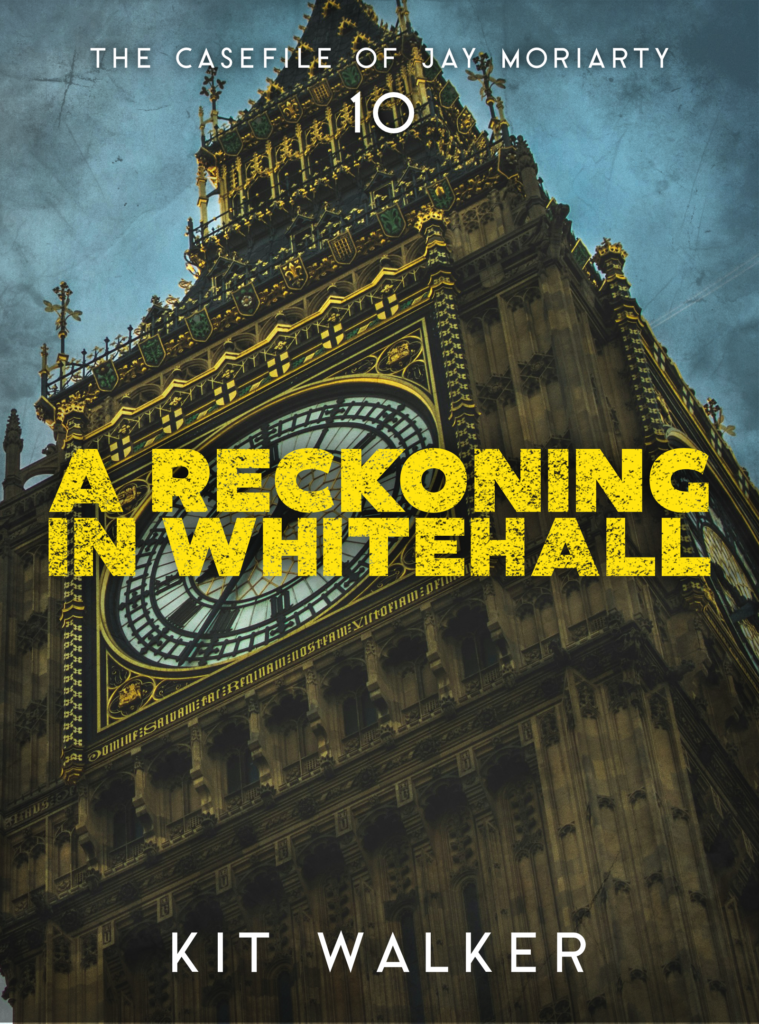
Jason Collier is on his way up in the world. Wealthy and well-educated, he’s translated a successful business career overseas into a parliament seat at home in Britain. His marriage to one of the world’s most powerful tech executives has made him a key asset to the government. It is, in light of all this success, of little concern to anyone who matters that Collier has left a trail of violated and abused victims behind him.
Jay Moriarty isn’t anyone who matters — but twenty years ago, Jason Collier hurt a young boy named Sebastian Moran. For that, Moriarty is going to destroy him.
The final chapter of “A Reckoning in Whitehall” has been published on the Casefile of Jay Moriarty website! You can read the entire story free online, or get it as an ebook.
This Week’s Links
Those who ‘circle back’ and ‘synergize’ also tend to be crap at their jobs
People who scored higher on the Corporate Bullshit Receptivity Scale tended to perform worse on tests measuring analytical thinking, cognitive reflection, and fluid intelligence. They also made poorer judgments in workplace decision-making scenarios designed to mimic common business problems.
In other words, the employees most impressed by corporate jargon were also the ones least likely to think critically about it.
Bound: Be Gay, Do Crime
It’s tempting to reinscribe an essentialist reading, and see Bound as a trans film now because it was made by trans filmmakers. Or we could think of transness in cinema a little more expansively. In his book Lana and Lilly Wachowski, Cáel M. Keegan suggests that we read Bound as an “invitation to sense differently.” Which is a part of the trans experience—we feel a truth via the body that appearances belie. In Bound, we find the beginnings of a journey into a certain trans sensibility that runs through all the Wachowskis’ work.
Pseudoscience in the Witness Box
Of 28 examiners with the FBI Laboratory’s microscopic hair comparison unit, 26 overstated forensic matches in ways that favored prosecutors in more than 95 percent of the 268 trials reviewed so far.
Would you believe this is not even the first time I’ve quoted that bit from Broadcast News?
-K
